
I started using the term CoIQChange because I kept seeing the same failure pattern in organizations that were otherwise smart, well-funded, and full of capable people.
They would invest heavily in change. New strategy decks. New systems. New org charts. New language.
Then execution would slow. Managers would revert to old habits. Teams would interpret the change in different ways. Performance would become uneven. People would blame “culture” as if it were weather.
What I came to believe is that many change efforts fail for a simple reason. They try to move an organization forward without upgrading the organization’s competence to change.
That is what CoIQChange is.
CoIQChange stands for Competency Intelligence for Organizational Change.
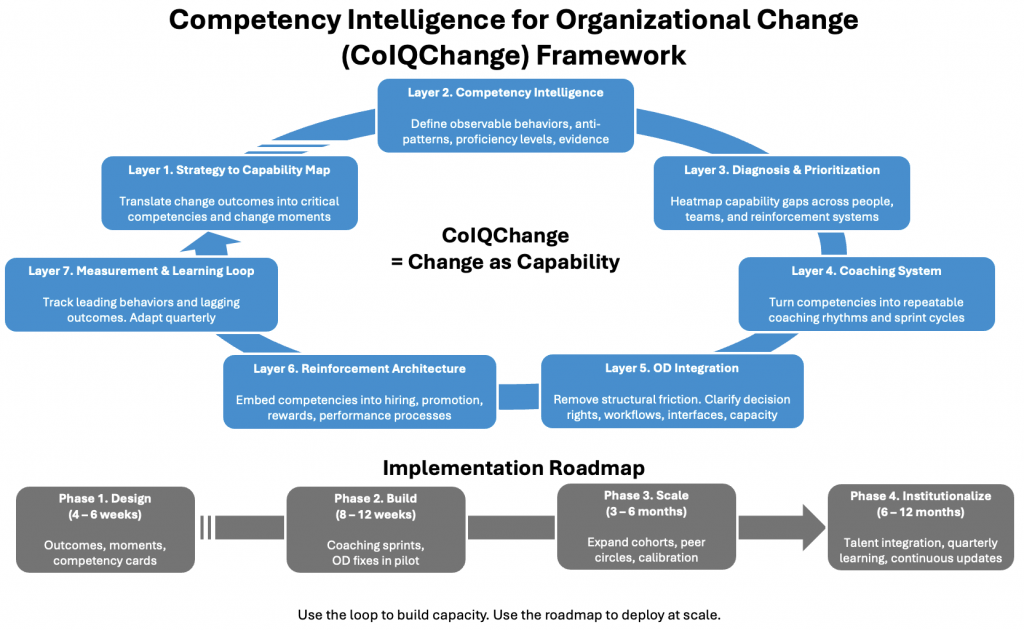
It is the discipline of identifying the few capabilities that truly drive successful change in your context, translating them into observable behaviors, building them through performance coaching, and reinforcing them through systems, leadership routines, and measurement.
In plain terms, CoIQChange is how you make change executable.
What makes it different
Most change initiatives focus on messaging and alignment. Those matter, but CoIQChange focuses on something more operational.
It asks questions like:
- What capabilities must be strong for this change to work, consistently, across managers.
- What does “good” look like in observable behavior, not slogans.
- Where are the real capability gaps, at the individual, team, and system level.
- How do we build the capability through coaching rhythms and not one-off training.
- What will we reinforce, measure, and reward so the change survives pressure.
It is not another framework to admire. It is a way to build a repeatable performance engine inside the change.
How CoIQChange benefits organizations
1) It turns change from persuasion into capability building.
Instead of hoping people “buy in,” you develop the skills and behaviors needed to execute. Change becomes less emotional and more practical.
2) It creates clarity that reduces friction.
When competencies are defined behaviorally, people stop guessing what leaders mean by “ownership,” “agility,” or “strategic thinking.” Coaching becomes easier because standards become shareable.
3) It scales coaching beyond a few strong managers.
Organizations often depend on a handful of managers who coach well. CoIQChange helps you build a consistent coaching language and rhythm, so performance coaching becomes a system, not a personality trait.
4) It improves decision quality in talent and performance management.
When change is tied to competencies, you can hire, promote, develop, and evaluate against what the strategy actually needs. You reduce noise and increase fairness.
5) It makes progress measurable without becoming bureaucratic.
CoIQChange supports a practical scoreboard. A few leading indicators of behavior. A few lagging indicators of performance. Enough to learn and adjust, not enough to drown in reporting.
A simple example
If your strategy requires faster innovation, the real question is not “How do we inspire innovation.”
It is “Do our leaders have the competence to run experiments, tolerate intelligent failure, prioritize learning, and make decisions with imperfect information.”
If those competencies are not developed and reinforced, the organization will default back to risk avoidance, approval chains, and safe thinking. The change will look alive in presentations and die in day-to-day behavior.
That is why I care about CoIQChange. It gives leaders a way to work with reality.
If you are building a coaching culture, leading transformation, or trying to make strategy executable, CoIQChange is the bridge between intention and performance. If you want support designing that bridge, this is exactly the work I do, and it is also the thread that runs through my book on performance coaching and organizational performance.